Get A Free Quote
内页banner
optical sorting machine
Home

optical sorting machine

  • Quality Competition in the Roasted Snack Market Lies in the Sorting of a Single Peanut Quality Competition in the Roasted Snack Market Lies in the Sorting of a Single Peanut
    Nov 02, 2026
    For holidays and everyday binge-watching, peanuts and sunflower seeds have long been a widely popular casual roasted snack — a household staple. Market demand is stable, but consumers are increasingly demanding when it comes to appearance and taste. Among in-shell peanuts, the presence of shriveled nuts, mud-stained black-spotted nuts, and broken nuts directly determines pricing, repeat purchases, and brand reputation. Mud-stained black-spotted nuts, in particular, mostly come from peanuts that picked up soil while growing — their shells are covered in mud spots, look black and dirty, and stand out conspicuously when mixed into finished products. They must be thoroughly removed. Many roasted snack processing plants face the same challenge: in-shell peanuts are round and smooth, making them prone to slipping, rolling, and stacking — leading to unstable recognition and frequent missed detection. In addition, materials slide down by gravity and collide on impact, causing frequent breakage and persistently high production losses. The HAWIT High-Speed Belt Color Sorter is designed specifically for materials like peanuts that roll easily and are prone to breakage — smooth conveying, industrial camera recognition, and precise removal of defective peanuts. To visually demonstrate the sorting effect, we conducted an in-shell peanut machine test.  peanut       ➡ Before the test, we evenly mixed defective black peanuts into qualified peanut raw material and blended thoroughly to recreate the real-world mixed incoming material scenario at a processing plant. belt sorter       ➡ The mixed peanuts were continuously fed into the belt-type color sorter. The material spread flat on the smoothly running conveyor belt and was carried forward at a constant speed by the belt. No rolling, no stacking. The root cause of peanut rolling and stacking is eliminated. Every peanut spreads out steadily, giving the vision system a stable recognition surface. Soft contact, low breakage. Gentle soft-contact conveying throughout — no more high-speed impact on sliding chutes — greatly reducing the probability of peanut shell cracking and preserving finished product integrity while cutting unnecessary material loss. High-speed operation, high throughput. The belt runs fast with high processing capacity per unit time, meeting the demands of large-scale roasted snack processing. sorting result       ➡ Sorting Results Finished product: Premium peanuts — plump, uniform in color, and consistent in appearance. Rejects: Black peanuts with obvious mud staining and blackening. For roasted snacks that sell well, quality is the foundation. Stable and controllable sorting helps processing plants hold the first line of quality control. HAWIT High-Speed Belt Color Sorter — Stable sorting results, lower breakage rates, and every peanut clean and flawless. HAWIT Technology — Making Sorting Smarter.
    Read More
  • Wheat Sorting Comparison Test | RGB vs. NIR vs. AI – Performance Review Wheat Sorting Comparison Test | RGB vs. NIR vs. AI – Performance Review
    Aug 15, 2026
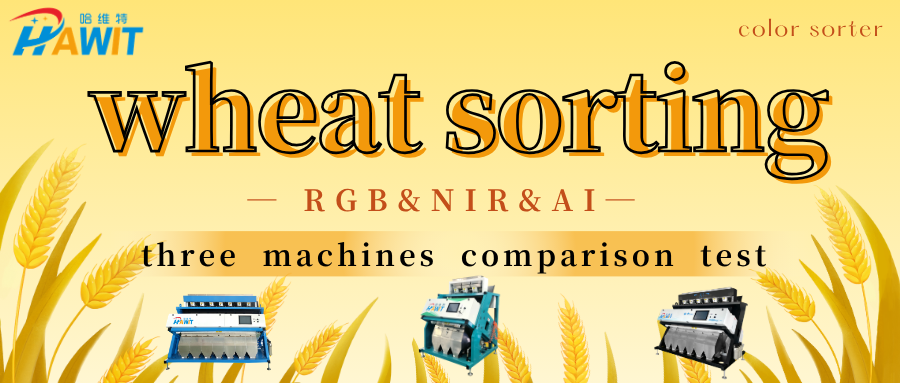
    In wheat processing, impurities come in many forms – transparent crushed glass, off-color wheat kernels, black and white stones, long and short straws, and wheat husks are all stubborn contaminants that are difficult to remove completely. They directly affect final product quality and market value.   In this test, we used a uniform set of test materials to conduct a side-by-side comparison of three color sorters with different technological approaches, giving you a clear look at their sorting capability.   Impurity List for This Test   2026 / 08 / 15 Impurity Type Characteristics Transparent crushed glass Colorless and transparent, different material from wheat Black stones Deep black, highly contrasting with wheat White stones Whitish, different shape and material from wheat Black rice Deep black, similar shape to wheat Brown wheat Darker color, same shape and material as wheat Long straws Elongated, yellowish in color Short straws Short straw pieces, different shape and material from wheat Wheat husks Similar size and color to wheat, different material   Test Rules   2026 / 08 / 15   RGB standard model & NIR model: Equal quantities of impurity samples were added. AI HD intelligent model: More impurities were added overall – with transparent crushed glass quantity doubled compared to the other two machines – to increase sorting difficulty. Hardware differences: RGB and NIR models are equipped with SD cameras; the AI model features an HD recognition camera.   Technology Principle & Test Results   2026 / 08 / 15 RGB       RGB Standard Color Sorter (SD camera) Relies on color and shape features to identify impurities. In this test, it successfully removed all impurities, meeting basic production standards. However, due to limited imaging resolution of the SD camera, for impurities with similar appearance to wheat (such as short straws and brown wheat), the judgment threshold had to be widened to ensure removal, resulting in a slightly higher carryover ratio. NIR       NIR Near-Infrared Color Sorter (SD camera + NIR) Adds near-infrared technology to RGB, enabling not only surface color impurity sorting but also identification of materials with internal defects. NIR adds a material property dimension, allowing more accurate recognition of "same-color, different-material" impurities without needing to expand the color threshold – achieving a lower carryover ratio. AI       AI HD Intelligent Color Sorter (HD camera + AI algorithms) As a next-generation high-end model, it is equipped with an HD imaging camera. In this test, we increased the difficulty by doubling the amount of glass impurities – yet it still removed all impurities with precision, demonstrating strong anti-interference capability. The HD camera provides clearer images, and AI algorithms deliver more accurate judgments, with a clear boundary between impurities and acceptable products – making it suitable for most production lines.     All three models deliver complete impurity removal with clean, uniform wheat output. The key differences are in carryover ratio and hardware — pick the one that fits your needs. Welcome for free sample testing — let us customize your ideal sorting solution! ✨
    Read More

Need Help? leave a message

Please Leave A Message Here For Your Inquiry
If you are interested in our products and want to know more details,please leave a message here,we will reply you as soon as we can.
Submit

Home

Products

whatsApp

contact