Rice Sorting Field Test | Can an AI HD Color Sorter Replace Expensive Infrared Equipment?
Sep 16, 2026
rice sorting
In rice processing, from harvesting and drying to transfer and storage, raw materials are highly susceptible to mixing with various fine impurities.
Among them, small stones and transparent glass fragments — nearly identical in size to ordinary rice grains — are the most troublesome impurities for rice mills.
These impurities are tiny and closely resemble rice grains. They may seem insignificant, but they are a core pain point for many rice mills:
✅ Fine transparent glass fragments and small stones of the same particle size hide perfectly among rice grains. Ordinary color sorters have large recognition blind spots and suffer from severe missed detection. ✅ Manual picking is time-consuming, labor-intensive, and extremely inefficient. Fine impurities are difficult to distinguish accurately by eye, and human fatigue easily leads to oversights. ✅ Residual fine impurities are hard to detect, directly lowering the grade of finished rice while creating serious food safety hazards and damaging product reputation.
In the traditional grain and oil sorting industry, it is widely believed that thoroughly removing fine stones and transparent glass fragments similar in size to rice grains can only be achieved with infrared color sorters. However, the high procurement cost of infrared equipment discourages many small and medium-sized rice mills.
Is there a solution with comparable performance and higher cost-effectiveness?
In this test, we conduct a real on-site machine trial to verify whether an AI HD Color Sorter can replace infrared equipment by accurately identifying and removing fine stones and mini glass fragments of the same size as rice grains.
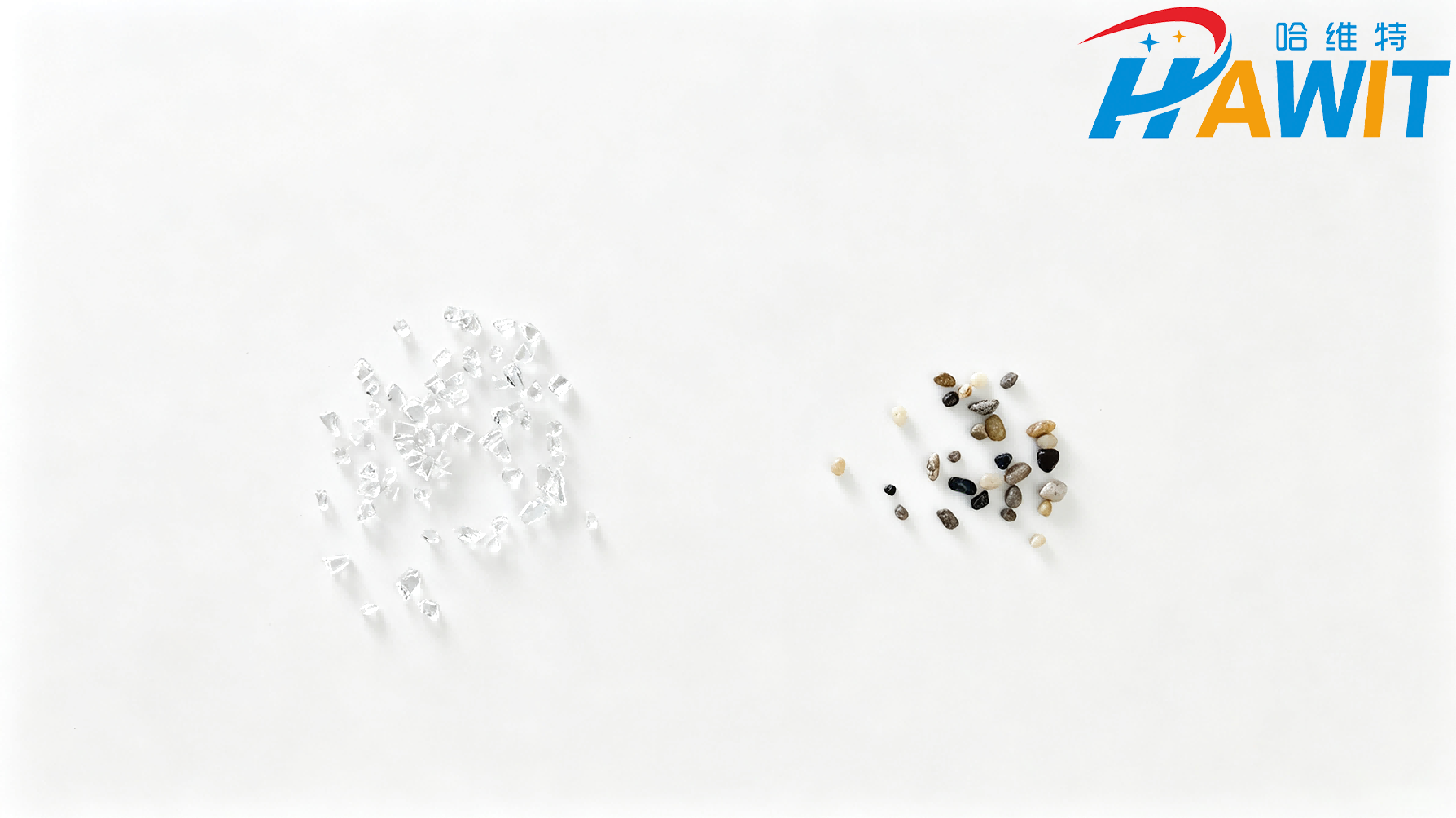
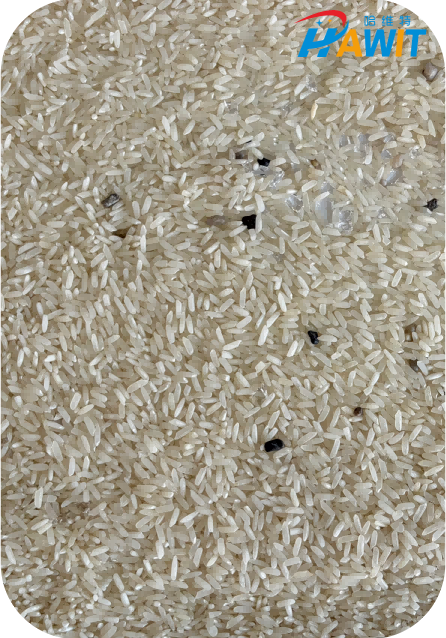
I. Test Materials: Rice + Small Stones & Glass Fragments To closely simulate actual factory production conditions, we manually and precisely prepared the test material, mixing two stubborn impurities into premium rice: fine sand and stones with particle sizes basically identical to rice grains, and mini transparent glass fragments.
【Caption: Core impurities in this test: small stones, transparent glass fragments】
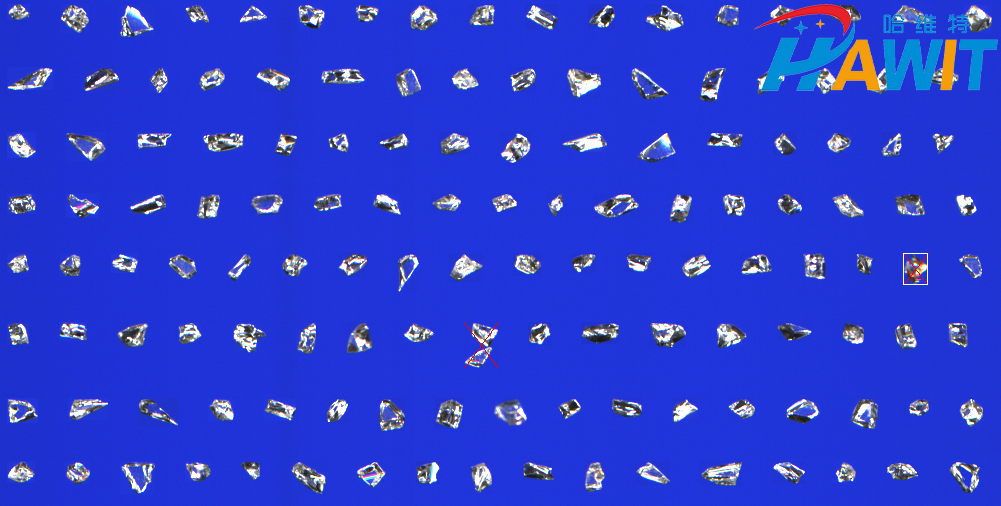
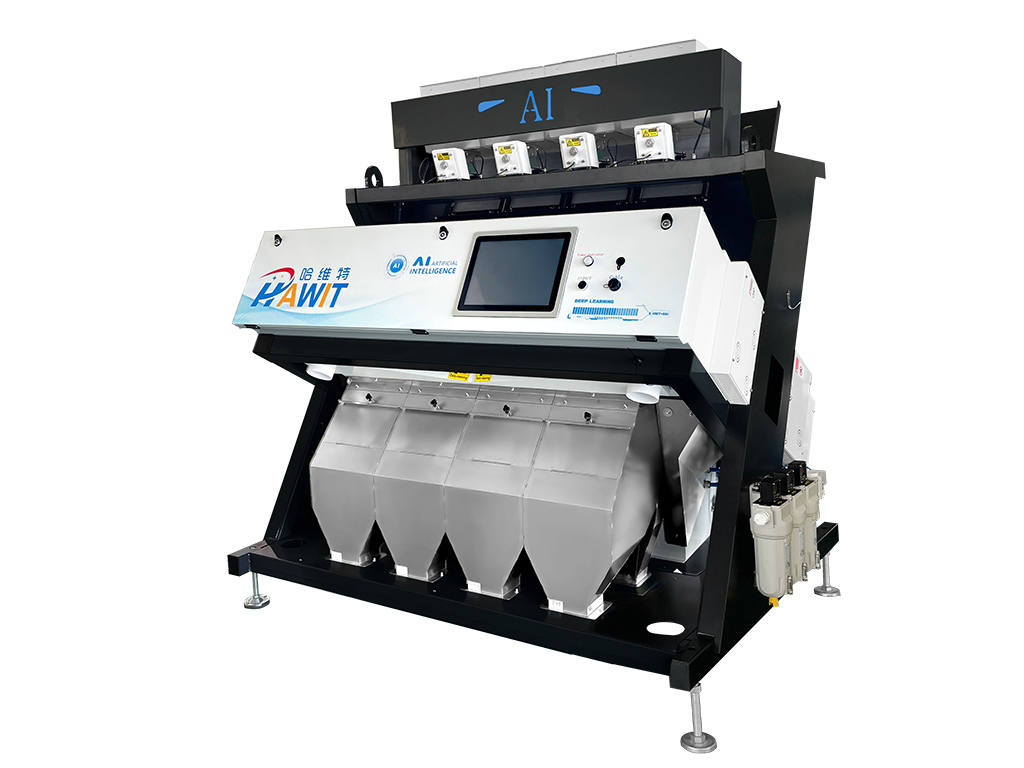
II. Test Equipment: Next-Generation AI HD Color Sorter The machine tested is an AI HD Deep Learning Color Sorter, equipped with HD industrial lenses and deep learning AI algorithm model, breaking beyond the recognition limitations of traditional photoelectric sorting. With high-resolution imaging, even micron-level fine foreign matter is captured in complete detail. It accurately distinguishes normal rice grains from difficult-to-detect impurities such as transparent glass fragments and fine small stones.
【Caption: HD lenses imaging — every tiny detail revealed】
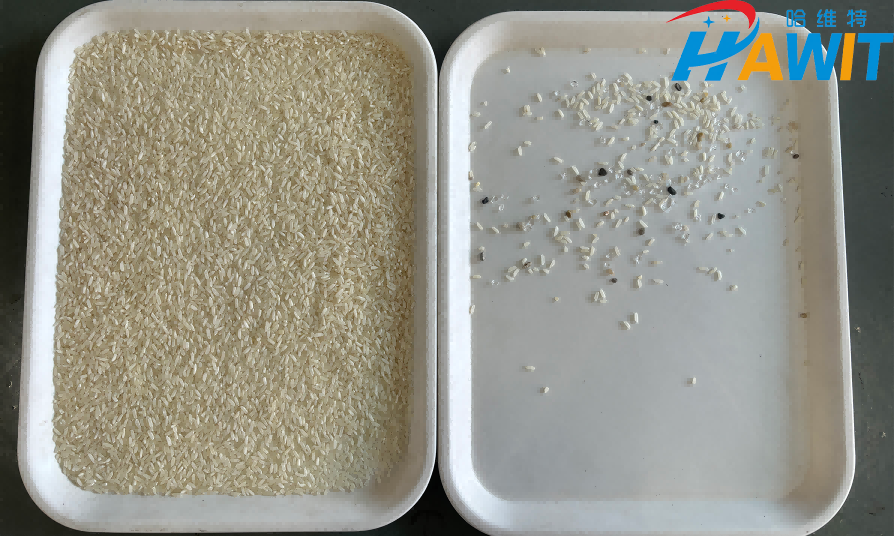
III. On-Machine Test Process: AI HD Precision Sorting The rice material mixed with stones and glass fragments is evenly fed into the AI HD Color Sorter’s inlet, and the machine performs fully automatic high-speed sorting. The HD lens captures the details of every particle in milliseconds, while the AI algorithm compares and analyzes in real time: ✅ Normal premium rice → flows out through the finished product channel ✅ Fine stones, transparent glass fragments → precisely rejected by air jets into the waste area The entire process runs automatically without manual intervention, with fast sorting speed and high precision.
【Caption: Sorting effect comparison: accept on the left, reject on the right】
IV. Test Results Comparison: Impurities Completely Eliminated After sorting, the results are clear at a glance: The small stones and transparent glass fragments mixed in the raw material are removed. The finished rice is clean and translucent, with no residual impurities, fully meeting the quality inspection standards for high-end rice. The test fully proves that in rice stone removal and glass fragment removal scenarios, the AI HD Color Sorter’s performance fully matches infrared equipment.
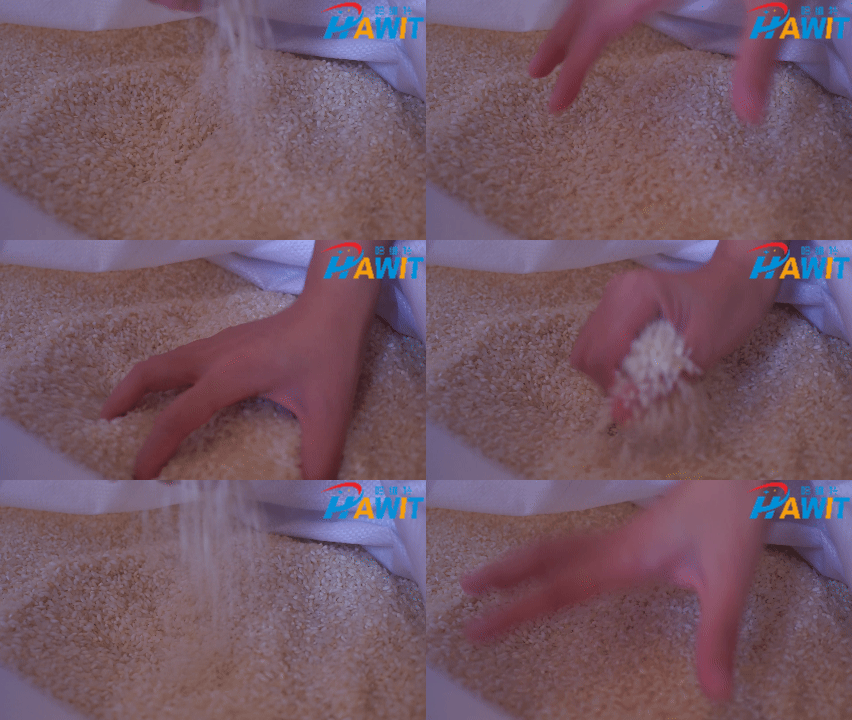
【Caption: Accept rice after sorting】
V. Core Advantages: AI HD Color Sorter — A Perfect Replacement for Infrared For the most critical rice processing scenarios — removing stones and glass fragments — the AI HD Color Sorter, relying on HD industrial lenses to capture fine material details, offers strong replacement value:
1. Equivalent performance, maximum precision — HD industrial lenses capture the texture and contours of rice-grain-sized foreign matter, combined with AI deep learning algorithms, delivering sorting precision comparable to near-infrared equipment.
2. Lower price, significant cost reduction — No need to bear the high procurement cost of infrared equipment, enabling faster return on investment and profitability.
3. One machine, multiple uses, comprehensive quality improvement — In addition to stones and glass fragments, it can also remove moldy rice, yellow kernels, chalky kernels, and off-color rice grains.
【Caption: AI HD Color Sorter field test — rice sorting site】
The arrival of the AI HD Deep Learning Color Sorter breaks the industry’s fixed mindset that “only infrared can handle fine impurities in rice.” With equivalent sorting performance, lower procurement costs, and simpler operation and maintenance, every rice processing plant can achieve intelligent precision sorting at low cost. HAWIT AI HD Color Sorter — making every grain of rice stand up to inspection.
Materials from different origins and categories have different impurity conditions. We welcome you to send samples for testing. We will provide one-on-one live machine demonstrations and free customized sorting solutions!
 English
 Español







 IPv6 network supported